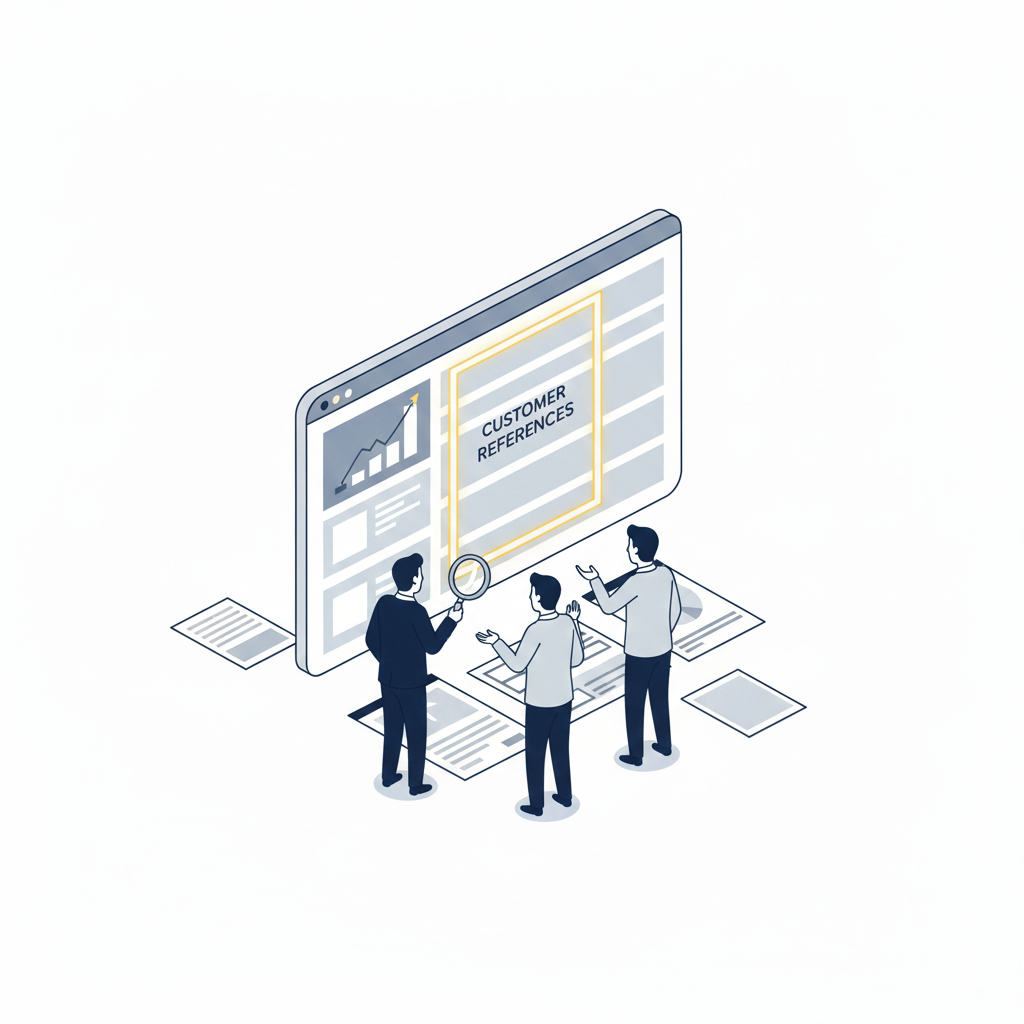
Dedicated SaaS Platform vs Homemade AI Agent: The Real Build vs Buy Math
A Custom GPT can be assembled in days. A production-ready customer reference platform cannot. Time-to-market, engineering effort, business workflows and 3-year TCO: what the Build vs Buy decision often overlooks.
The rapid rise of large language models (LLMs) and AI agent builders — "Custom GPTs" and the like — has created a common illusion among IT and sales leaders: the belief that a full business application can be replaced by one or more AI agents built in-house.
It is true that a prototype AI agent capable of handling specific tasks can be put together in a few days. But there is a structural gap between a demo AI assistant and an industrial-grade enterprise software platform shaped by decades of field experience.
1. The illusion of simplicity
An enterprise AI agent or Custom GPT easily solves one building block: natural-language information retrieval and text generation. It leaves most of the operational challenges unresolved — on-brand distribution, legal compliance, data governance and sales team engagement.
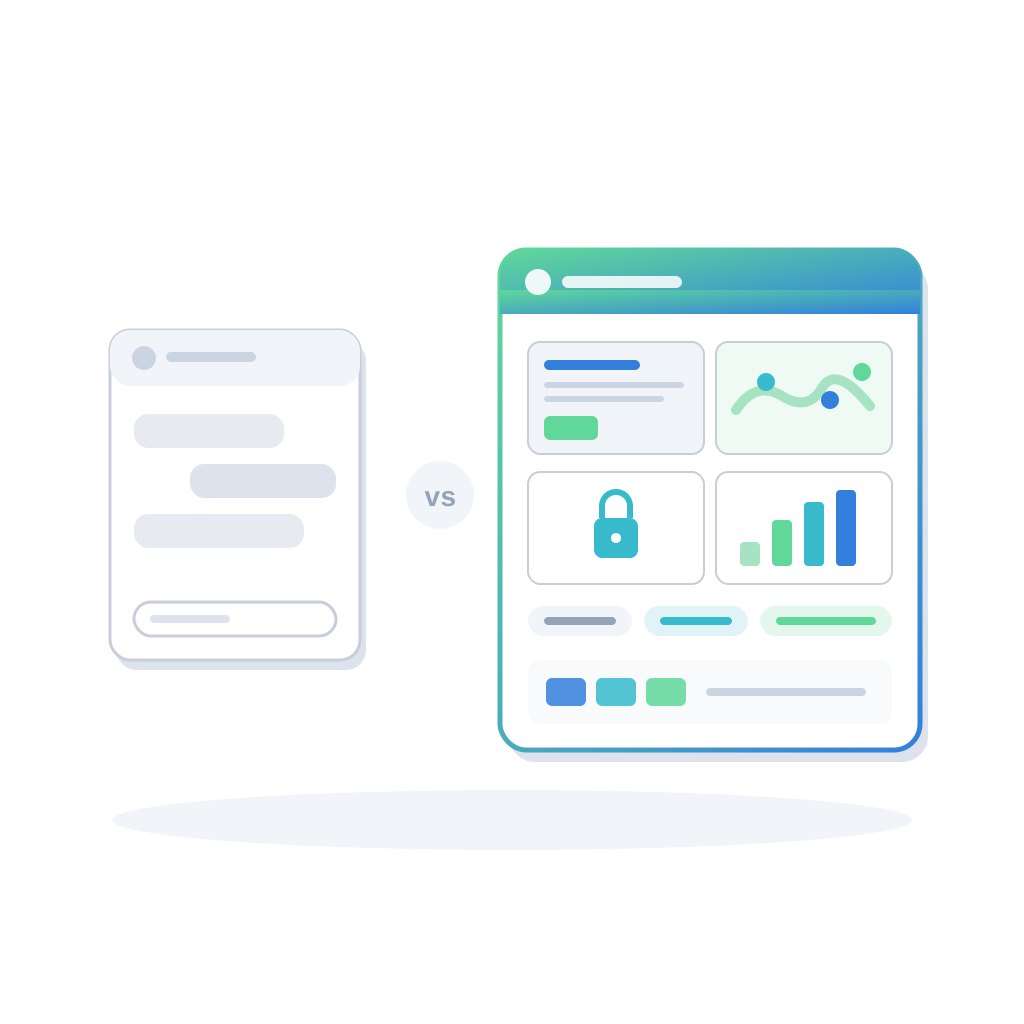
AI agent Runs a text search and returns informal answers in a chat window, with no precise control over layout, no fine-grained permissions and no brand integration.
Integrated business platform (SaaS) Provides a dynamic PowerPoint export engine that respects your brand guidelines, handles multi-level legal consent collection through secure public links, encrypts data at the application level (AES-256-GCM) and measures adoption through analytics and dynamic mapping.
2. The time equation and time-to-market
One of the biggest biases in a Build vs Buy decision is to only estimate the time needed to get a working prototype (Proof of Concept), while ignoring the full cycle: production rollout, UX/UI design, acceptance testing and ongoing maintenance and operations.
| Dimension | Homemade AI agent (Build) | Dedicated SaaS platform (Buy) |
|---|---|---|
| Time to go live | 1 to 3 months (specs, development, testing, deployment) | Immediate (day 1) |
| IT resources required | High (AI engineers, full-stack developers, UI/UX) | None (turnkey solution) |
| Maintenance & operations | 15% to 20% of initial cost per year (API changes, fixes) | Included in the subscription |
| AI model upgrades | Manual (handling API breaking changes) | Seamless and continuous |
| Annual cost for 10 users | €15,000 to €30,000 / year (maintenance + hosting) | €1,800 / year (€15/user/month) |
The opportunity cost is significant: while your internal R&D team spends months building a secondary tool, it is not working on the company's core product. A specialized SaaS, by contrast, delivers immediate operational value for a few hundred euros per user per year.
3. The engineering weight: 4,000+ hours of R&D vs an internal prototype
A mature business platform like Hublyd is the result of more than 4,000 hours of software engineering, including the use of modern AI tooling to speed up development.
When an internal team estimates it can build an alternative on a modest budget (say €30,000 to €50,000), that represents roughly 300 to 500 hours of senior engineering time — about 12% of the R&D volume of a mature solution.
- Dedicated SaaS platform: 4,000+ cumulative R&D hours (PPTX engine, security, GDPR, analytics, multilingual support, approval workflows).
- Internal prototype (MVP): ~480 development hours, for a partial product with no advanced features.
A 480-hour internal project will only produce a narrow-scope tool:
- a basic user interface that does little to engage sales reps;
- edge cases and input errors left unhandled;
- no advanced layout, governance or compliance features.
4. Business maturity: 25+ years of built-in Sales & Marketing experience
The real difference between a specialized SaaS and a homemade project lies in the depth of its business workflows. Hublyd natively embeds more than 25 years of hands-on B2B sales and marketing experience gathered by its founders. An internal build or an AI prompt can hardly anticipate the realities of the sales field without many iterations.
Publication-level governance (Draft / Private / Public)
The field reality: not every reference is ready to be shared externally. A case study still being written, or one containing confidential financial data, should not be visible to the entire sales force.
What the platform brings: fine-grained publication states.
- Draft — work in progress, being entered or enriched by marketing or the project manager.
- Private — internal use only, to brief sales reps, with no external distribution.
- Public — formal approval obtained for commercial reuse and sharing with prospects.
Multi-level consent workflow (operational contact vs authorized signatory)
The field reality: in complex B2B sales, the customer's technical lead or project manager who provides the case details is almost never the person authorized to sign the reference agreement (DPO, legal department, C-level). A single form systematically stalls the process — what we call the consent gap.
What the platform brings: a consent flow split into two steps.
- Technical collection — the operational contact fills in and validates the project details.
- Legal approval — a separate secure link is sent to the legal signatory to collect formal, timestamped agreement (GDPR).
Native international approach (multilingual and regional formats)
The field reality: international sales teams manage references in several languages, with region-specific date, time, currency and unit formats.
What the platform brings: instant translation of reference sheets and slides, native multilingual management and automatic adaptation of regional formats for smooth global rollout.
5. Technical building blocks out of reach for a simple AI agent
Beyond business workflows, several technical hurdles prevent the "AI agent" approach from meeting the needs of a sales organization.
A custom PowerPoint (.pptx) export engine
The AI limitation: LLMs cannot place graphic elements pixel-perfectly inside a .pptx file while strictly enforcing brand guidelines (corporate fonts, reserved zones, image ratios, text overflow rules).
What the platform brings: a dedicated rendering engine that dynamically injects filtered data into the company's official PowerPoint masters, generating editable, client-ready presentations in one click.
Advanced security: AES-256-GCM encryption and Zero Model Training
The AI limitation: internal scripts often store data in plain text in standard vector databases, exposing the company to data leaks and unwanted model training.
What the platform brings: application-level data encryption (AES-256-GCM at the ORM level), key management through a secrets manager (Doppler) with automatic rotation every 90 days, and Enterprise API contracts guaranteeing Zero Model Training.
Dynamic mapping, analytics and gamification
The AI limitation: a POC AI agent provides neither spatial representation nor adoption tracking across teams.
What the platform brings: interactive geolocation of references on a world map, data completeness KPIs and engagement dashboards that encourage team contributions.
6. The financial picture: 3-year TCO
When you add up every cost — initial investment, recurring maintenance, cloud infrastructure and support — the Total Cost of Ownership (TCO) analysis clearly shows the economic advantage of the SaaS model.
Cumulative 3-year TCO (10 users):
- Dedicated SaaS (Podium plan): €5,400
- Internal build (low range / MVP): €45,000 to €65,000
- Internal build (high range / extended): €145,000 to €210,000
| Cost item | SaaS (10 users) | Internal build (low range) | Internal build (high range) |
|---|---|---|---|
| Initial investment (CAPEX) | €0 | €35,000 to €50,000 | €100,000 to €150,000 |
| Subscription / license (3 years) | €5,400 (€1,800/year) | €0 | €0 |
| Maintenance & cloud (3 years) | Included | €10,000 to €15,000 | €45,000 to €60,000 |
| Total 3-year TCO | €5,400 | €45,000 to €65,000 | €145,000 to €210,000 |
The SaaS model turns a heavy, unpredictable capital expense (CAPEX) into a modest, predictable operating cost (OPEX) that pays for itself immediately.
7. Summary and recommendation
Building an internal AI agent to query documents is an excellent technology experiment. But to meet the operational demands of a modern sales force, that prototype must be completed with a multitude of complex building blocks and business subtleties that only deep field experience can design.
Recommendation for the executive committee: keep internal R&D focused on the company's core business and unique value, and choose a specialized SaaS platform backed by 25+ years of Sales & Marketing expertise — same-day deployment, an annual cost that is marginal compared to development costs, and guaranteed continuous evolution.
Want to see the difference for yourself? Start for free with Hublyd and roll out your reference library today.
Explore the platform: Customer reference management with Hublyd — structure, govern and activate your customer proof without building anything in-house.
Ready to transform your sales process?
Start generating presentations from your customer references in seconds.
Start Your Free Trial